

11.Feb 2026
Safe Handling of Hose Coils Using the CH29 / CH35 Pneumatic Lifter
Handling hose coils is often complex and risky. Coils are heavy, bulky, and difficult to grip. Conventional means such as slings, chains, or hooks often lead to hose damage or unstable handling.
Typical Problems When Handling Hose Coils
- High weight and large coil diameter increase the demands on grip stability and lifting safety.
- Ambiguous gripping points when using conventional lifting equipment lead to unstable suspension.
- Risk of deformation or damage to the hose due to point loading by textile slings, chains, or hooks.
- Undesirable swaying and rotation of the coil during handling, which complicates precise positioning and increases the risk to operators.
Internal Gripping Solution
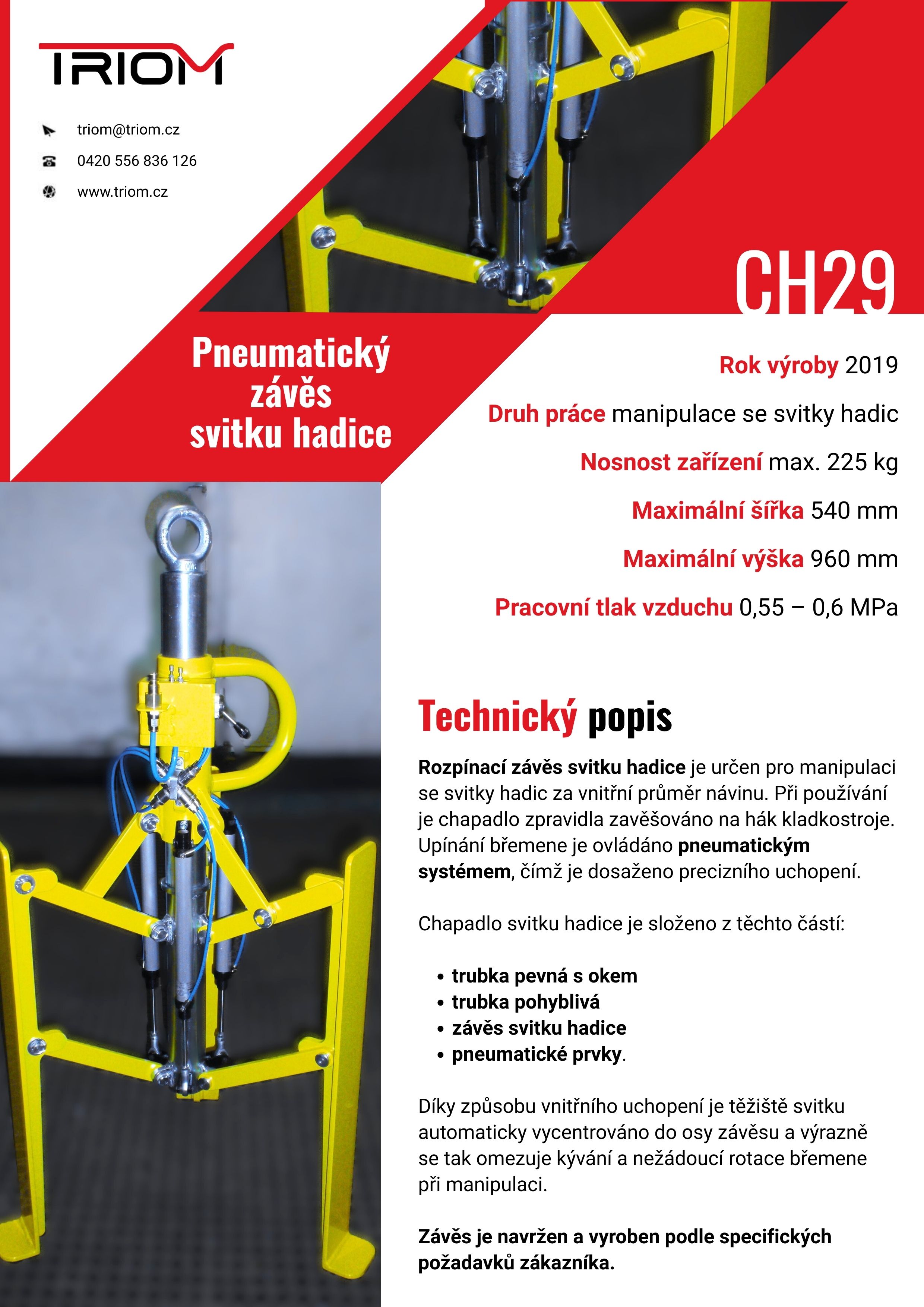
The CH29 / CH35 pneumatic lifter grips the coil from the inside of its opening. The expanding mechanism opens inside the inner diameter of the coil and evenly supports it around the entire circumference.
The result is:
- even force distribution without material damage,
- automatic centering of the coil along the lifter axis,
- significant reduction of swaying and rotation,
- stable and safe handling.
Areas of Application
Pneumatic hose coil lifters CH 29 / CH 35 are designed for handling in industrial operations, for example:
- hose warehouses
- production and assembly halls
- logistics centers
- winding and unwinding workstations
Basic Technical Parameters
- Type of operation: pneumatic hose coil lifter
- Load capacity: 225 kg
- Dimensions: maximum height: 960 mm, maximum width: 540 mm
- Working air pressure: 0.55 – 0.6 MPa
- Environment: standard AA5 according to ČSN 332000-5-51
Device Design
The lifter is designed to be suspended from a hoist hook or other lifting equipment. Clamping and releasing of the coil are controlled pneumatically.
Main components:
- fixed tube with eye
- movable tube
- hose coil lifter
- pneumatic components
The pneumatic hose coil lifter is intended for use in a standard industrial environment according to ČSN 33 2000-5-51 (environment AA5). The device does not require special operating conditions in terms of temperature, humidity, or chemical exposure and is adapted to normal operational loads.
The lifter is controlled by compressed air, which manages both clamping and releasing of the coil. Compared to mechanical lifters, it offers greater control, repeatability, and less dependence on operator experience.
The robust design enables long-term use even with a high number of handling cycles.
Operating Principle
After connecting the lifter to a compressed air source, the operator activates the clamping mechanism. It expands inside the inner diameter of the coil and simultaneously supports its lower part.
Releasing the coil is performed by venting the pneumatic system and returning the expanding elements to their initial position.
Operational Benefits
- higher workplace safety,
- protection of hoses against damage,
- fast and intuitive operation,
- compatibility with common lifting equipment,
- minimal maintenance requirements.
Why Use a Pneumatic Hose Coil Lifter?
| Conventional Methods | Pneumatic Lifter CH 29 / CH 35 |
|---|---|
| point loading | even force distribution |
| unstable suspension | automatic centering |
| risk of hose damage | material protection |
| dependence on operator experience | controlled process |